
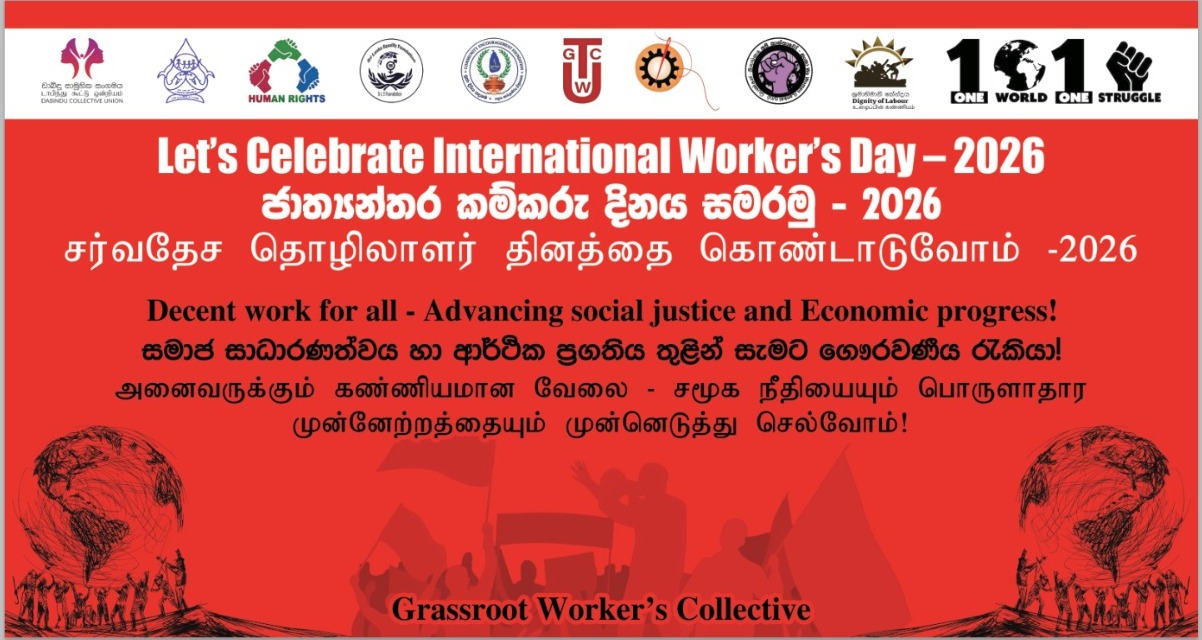

Decent Work for All – Advancing Social Justice and Economic Pogress!
International Labour Day 2026 – Katunayake
Dabindu Collective Union – International Labour Day Statement
For forty- three years, the Dabindu Collective has stood with women workers at the heart of Sri Lanka’s garment industry. For the past five years, we have intensified Women – led unionizing efforts in a sector built on the labour of women. In 2026, we mark International Labour Day in Katunayake—at the center of the Free Trade Zone economy—together with eight women’s rights organizations representing garment, fisheries, and plantation workers.
This year, we speak from a moment of deepening crisis.
The garment industry is collapsing its risks onto workers. Global brands, factory owners, and the State continue to protect profits while pushing instability, wage suppression, and job loss onto women workers. Factory closures are increasing. Production targets are intensifying. Contracts are becoming more insecure. Workers are being treated as expendable.
Let us be clear: this is not an “economic crisis” for everyone. It is a crisis imposed on workers.
Today, the exploitation system is fraught with economic instability and severe pressure from a global crisis, further intensified by escalating warfare, militarism, and geopolitical trade conflicts. These forces are disrupting global production and supply chains, while being used to deepen the exploitation of labour. Garment-producing countries like Sri Lanka face heightened uncertainty as supply chains and shipping routes are destabilized, leading to declining livelihoods, rising unemployment, and growing insecurity among workers.
The impact of these conflicts goes far beyond immediate disruptions—it is systematically destabilizing economies and pushing workers into more precarious conditions. In response, global luxury brands are protecting their profits by cancelling or reducing orders, delaying payments and deliveries, and shifting sourcing between countries. The burden of this instability is not shared equally—it is transferred downward onto factories and, ultimately, onto workers.
For decades, women workers have subsidized this industry with their underpaid labour, unpaid care work, and compromised health. Today, they are being asked to absorb yet another layer of crisis—one they did not create.
We reject this.
The normalization of exploitation continues through:
- Extended working hours beyond legal limits without proper compensation
- Increasing use of temporary and informal contracts to avoid accountability
- Wage systems that fail to meet basic living costs
- Production targets that damage workers’ physical, economic and mental health
- Systematic suppression of trade unions and retaliation against worker leaders
At the same time, women workers carry the invisible burden of unpaid care work. There is no national care system, no adequate childcare, and no structural recognition of women’s double work. Instead, proposed labour “flexibility” reforms aim to extract even more labour from women while deepening insecurity.
Gender-based violence and harassment remain embedded within the garment sector—from factory floors to transport to boarding houses. These are not isolated incidents but structural features of this industry.
Despite legal protections, freedom of association is increasingly undermined. Union-busting, intimidation, and surveillance are intensifying—particularly in Free Trade Zones. Workers are denied their fundamental rights to organize, to speak, and to collectively bargain.
Meanwhile, the State continues to align with corporate and global interests—failing to regulate, failing to protect, and enabling exploitation through policy decisions.
We refuse to accept a system where workers are forced to bear every crisis while profits remain protected.
Our demands in 2026 are urgent and non-negotiable:
- Guarantee job security and immediately halt unjust terminations and factory closures without compensation
- Establish a real living wage and enforce a fair minimum wage for all garment workers
- Strictly enforce the 8-hour workday and end all forms of forced and unpaid overtime
- End precarious employment by protecting workers on temporary and contract-based work
- Recognize unpaid care work and implement a national care system, including workplace childcare facilities
- Reform labour laws to strengthen protections—not weaken them
- Eliminate exploitative production targets and introduce state monitoring of factory practices
- Guarantee freedom of association, protect trade unions, and end all forms of union-busting
- Enforce zero tolerance for gender-based violence and harassment in and around workplaces
- Ensure paid leave, including sick leave, maternity, and parental leave
- Establish 24-hour Women and Children’s Protection Units in Free Trade Zones
- Introduce comprehensive social protection systems for all workers
- Ensure voting rights and civic inclusion for workers living away from their home districts
We further call on international brands to take full responsibility for labour conditions within their supply chains. Profit cannot be built on exploitation, instability, and the disposability of workers.
Women workers are not just labourers in factories—they are the backbone of households, communities, and the national economy. Their labour sustains industries, yet their lives remain insecure.
This must end.
This May Day, from Katunayake, we raise a collective voice of resistance. We stand not only against exploitation, but for a different future—one built on justice, dignity, care, and workers’ power.
Our labour is not cheap. Our lives are not expendable.
Decent Work for All – Advancing Social Justice and Economic Pogress!
Power to Workers’ Solidarity!
Dignity and Justice for All Women Workers!
Media Statement – English – 2026