
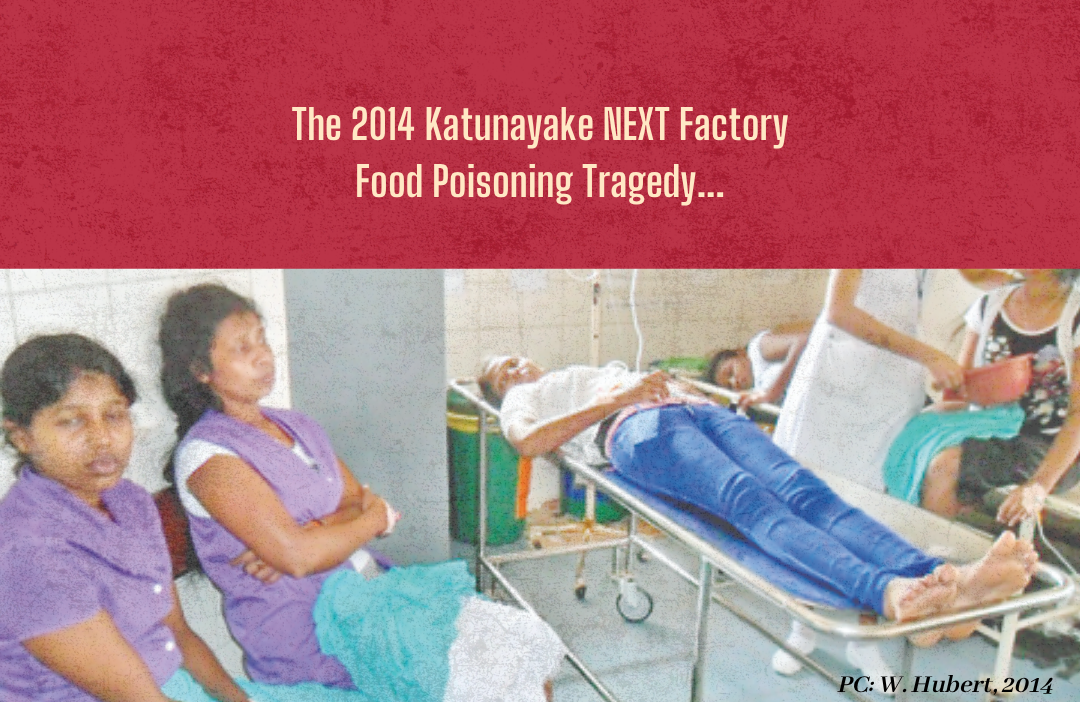

It takes 11 years and 52 days for a company in Sri Lanka to pay up for a death in their factory.
On 5 September 2014, 350 workers at the Katunayake NEXT factory fell ill after their mid-day meal. 150 of them were taken to the Negombo District Hospital. Two were admitted to the ICU. One —K. Gnanawathi, who had worked in the factory for seven years—lost her life.
The Judicial Medical Officer reporteed the cause of her death as a result from a blood clot. Her family, along with Dabindu and other trade unions, rejected this conclusion. Her body was exhumed for re-examination and with it the truth: the swelling in her intestines clearly indicated symptoms of food poisoning. What began as an ordinary lunch break became a struggle for truth. A truth that factory was eager to bury—and one that the complicit state was ready to deny—to prevent accountability for Gnanawathi and the workers who fell ill that day.
This case was first heard at the Negombo High Court and was eventually taken up by the Office of the Commissioner for Workmen’s Compensation. After a struggle of 11 years and 52 days for truth and justice, the Compensation Court has ordered the NEXT factory to pay compensation for Gnanawathi’s death. Thus, on 27 October 2025, the court delivered its verdict—bringing this case to a close. But this does not end here.
Since that day, workers in factories across the country have faced occupational health and safety hazards. Only a fraction of these incidents are reported. Many others—along with related information—are suppressed. It must especially be noted that not only food-related incidents, but also chemical exposure, unsafe machinery, and gender- and social-based violence are frequently covered up by garment factories and the state. This case marks a turning point for occupational health and safety in Sri Lanka’s factories. It exposes the abusive practices and corruption within the private sector, and the manner in which the state cooperates to silence the truth.
This 11-year struggle has been a call to defend the bodily autonomy of women workers, their occupational health rights, and the protective labour laws and rights they are owed. We extend our heartfelt gratitude to Leon Joseph and the legal team who continuously supported this struggle, as well as to Clean Clothes Campaign, the Urgent Action Fund, and the National Union of Seafarers.